Selasa, 12 Juli 2011

NY Jets #53 - Part 4

(We thought the rest of the season would be like this.)
Cody Spencer #53 was a linebacker for the Jets from 2006-08. He comes from Texas where I suspect a lot of guys are named Cody. He went to North Texas University and had a decent year in 2008, which was the Brett Favre season. He seems not to have an NFL career after his 2009 season with the Detroit Lions. I confess I don't remember much of his playing but I do recall that 2008 season, and I remember thinking how strange the world seemed, what with the hometown Phillies winning the World Series and Barack Obama becoming President-elect, and Brett Favre leading the Jets to an 8-3 start. At the far right of this picture you see Cody Spencer celebrating the away victory over the Patriots that year.  Things seemed just great.

The world seems like it is spinning back into more familiar territory now. The Phillies can't win the World Series without regular hitting, Obama is on borrowed time as President, and the Jets are as distant a memory to Brett Favre as he is to us. Sports and politics are the easiest way to gauge history simplistically.

But Cody Spencer is special because research on him produces one of those Wikipedia moments that is priceless. Recently I saw Jimmy Wales interviewed by Stephen Fry, and Wales talked about the extraordinary, simple beauty of Wikipedia as an information organization checked by volunteers. He said that it was remarkably American because it was started and maintained by ordinary people. This is all true, and though I tell my students not to rely on Wikipedia for their research, I do tell them that it's a great place to start. If I had been able to access it as a kid, I would have either done better research because I would have known where to begin, or I would fallen down the endless rabbit hole of links that Wikipedia often enables. Either way, I would have been happier. The world would have been more open to me.

But nothing - certainly not Wikipedia - is foolproof. Cody Spencer's Wikipedia page includes the following:

Spencer attended Grapevine High School in Grapevine, Texas where he taught Tommy France all about the hot boudin. As a junior, he helped lead his team to the Division I Class 4A State Championship.

There two bits of information here, but which is the more valuable? Which do you think - the bit about Tommy France, or the throwaway thing about Grapevine High School?  What are the essential qualities of a person? I don't know if someone should notify a Wikipedia volunteer, but then why bother? Isn't it important for readers to know that he taught Tommy France about the hot boudin? And what is the hot boudin? Is that a euphemism for something? Did Tommy put that there in Wikipedia, or did Cody? The Encyclopedia Britannica never allowed, however temporarily, for inside jokes, and maybe that's a shame. In real life, the hot boudin is spicy sausage indigenous to Cajun country. (And how did I find that out? You guessed it.) Is that all the hot boudin is to Cody Spencer and Tommy France? The world may never know, but if the world visits Spencer's Wikipedia page, where he exists in terms of two kinds of information juxtaposed together, they'll be presented with a complex picture of a person, at least until the Wikipedia volunteer edits out the most interesting part.

****

Jim Sweeney #53 came from Pittsburgh, he went to Pitt, then he ended up retiring with the Steelers in 1999. Today he apparently coaches high school football in the Pittsburgh area.  But he was a center for the Jets for a long time.  

What is it about centers?  The center has the opportunity for a long career, but with very little recognition.  The center never talks smack. He never taunts. He is, according to tradition, the guy who touches the ball first, the keynote and the keystone.  
Jim Sweeney is right up there with seasoned NFL offensive linemen. Draw a through line from Jets centers like #'s 52 MIke Hudock (1960-65), John Schmitt (1966-73), #65 Joe Fields (1975-1987) and you reach Jim Sweeney, who became the regular center for the Jets after Fields left, starting from 1984 to 1994. For better or for worse, that's a pretty remarkable record of stability at one position for such unstable Jets teams. 


Obviously there were other guys at center during the years 1960-84, like Wayne Mulligan and Warren Koegel, but the center is often the steady influence, the rock in the stream. Everybody could use a center, a person on whom you can rely to snap the ball with unerring regularity. He returns to the huddle with you, seeing you shake your head. What was I thinking? you ask yourself. Am I really as untalented as they say? Are they really saying that, or is that just in my head? 

No.  Get out of your head you say. I keep telling myself not to care about what anyone else thinks, but it just gets in there and drives me nuts. The center just stares at you and knows he's got to pull left or right or get in and push forward. He isn't plagued by your doubts; he has mastered the art of not listening to the constant trash talk from defenses come and gone, trying to distract him. He looks at you and simply waits for you to call out the next play. Get out of your head, he seems to say to you. You're not doing any good there. Between 1984 and 1994, amid adolescence and the unsteady transition to adulthood, like a quarterback drafted early on with great expectations, I could surely have used a Jim Sweeney. In that time, he snapped the ball to Ken O'Brien, Pat Ryan, Tony Eason, Browning Nagle, Boomer Esiason, Kyle Mackey, Mark Malone, and Jack Trudeau. That's a lot of disparate personalities struggling at the most public spot on predominantly losing squads.


****


How bad is it?
Linebacker Bill Zapalac #53 is also known as Willie Zapalac, Jr, the son of longtime NCAA and NFL assistant and coach Willie Zapalac, Sr. The Zapalac name may have been unknown to most Jets fans between 1971-73 when Zapalac the younger played for us, but in Texas, the Zapalacs are/were a football family. The elder attended Texas A&M, was a coach there and at the University of Texas, which is a little like coaching for the Jets and the Patriots (which, as we know, people have done). Willie Sr. built offensive lines at those schools, but Willie Jr. played defense at Texas while his father was assisting under Darryl Royal, which must have been interesting. Did he prefer defense just so that he wouldn't have to play under his Dad? Was he "Willie Jr." at Texas, or "Bill?"

He graduated from the Texas School of Applied Architecture and apparently helps run a construction company in Austin. Though there are no defensive statistics kept from his years in the NFL, other than starts at linebacker and defensive end, we can consult his 1974 card and consider the expression on his face. Is he wondering skeptically about the impending electrical wiring and concrete support system problems at Shea Stadium? Somebody would need to, eventually.

Kamis, 07 Juli 2011

NY Jets #53 - Part 3

Al Palewicz and the Winnfield
Since I check my lists for each number with the Jets' All-Time Roster, I get a view of what's to come, and I've been waiting to write about Al Palewicz #53. And yes, the reason why is because of that facial hair. Obviously, that's just one picture and not the whole of the man. It's a profile shot taken on the sideline at Shea Stadium in 1977 while he wasn't looking. From here he looks like a guy who might not take kindly to your gentle assertion that your date is only dancing with you in the road house. He also looks like the guy in that very same road house who challenges a shorter Burt Reynolds to a fight that initially seems to a mismatch, but Burt always manages through charming guile and luck to eventually put the bigger man on his back. And with that, yet another bar room brawl in a Carter-era, country-fried car movie commences. As fists and chairs fly about him, the man with the facial hair occasionally sits up, struggles to see what's happening, but collapses once again when he takes a fake bourbon bottle to the head. 

You might be tempted to call that facial hair the Fu Manchu. However, according to Dyers' Extended Beard Chart, it's more accurate to call it "the Winnfield," named for Julius Winnfield of Pulp Fiction. The Winnfield strikes fear in the hearts of extremely mild-mannered men like me, who realize that charming guile and luck are not going to do you any good when you're confronted by its wearer in the real world. "Say what again," the man in the Winnfield says. "I dare you, I double dare you...."

Al Palewicz was born in Texas, played for the University of Miami, and after the NFL became an English teacher. Yes. Today, though, he has what looks like a fine real estate business in the area in and around Miami. His bio on his company's page shows a successful-looking man in a sharp blue suit standing in the legendarily beautiful sunshine. Someday I would like to think I'll have an opportunity to buy a house from Al Palewicz. The canvas for the Winnfield is still barely visible on his face, but Palewicz has certainly moved on.  He's joined a better groomed world that the big guy who fought Burt Reynolds in the road house would probably only visit in order to steal copper piping for meth money.
Carl Russ' Winnfield,
with soul patch

Palewicz played linebacker for the Jets in 1977 after apparently being out of football for a year. Linebacker Carl Russ #53 joined the Jets in 1976 and then played another year for us, this time wearing #58. One thing is for sure - he too is sporting the Winnfield. His chops are a bit more formidable than Palewicz's, and Russ has the added panache of a soul patch. This combination could also be called the "Shaft," named of course for the character whose facial hair might well have influenced the development of the Winnfield in the first place.

According to his write-up for the Muskegon, MI Area Sports Hall of Fame, Russ played for the Atlanta Falcons his rookie year of 1975, and then the Jets the following year. He sprained his knee in 1976 but returned in 1977 to find that Al Palewicz was now wearing his former #53. He finished the season and retired at the ripe old age of 24. The Muskegon page doesn't say anything about Russ' life afterwards, but it talks about the real reason for his induction. Coming from Muskegon, Russ became a starter for Bo Schembechler at the University of Michigan after joining the team as a walk-on. This kind of story has a place in the heart of an America that I have never really understood, a place where the loyal eyes of half a state's fans can make a young man feel like a god each week. I suppose I've always valued the professional game more than the college one because in my own life I prefer to be treated like I am worth something at the bargaining table as an individual who earns for himself and his own well-being first. Schembechler's famous speech on the ideology of subordinating the self in favor of the team is sentimentally appealing, but it's hard to take seriously now. The various NCAA violations, particularly at Ohio State, indicate that favoritism, money, and material gifts to players complicate the supposedly purer way of football, and they probably always have.

Today, it's going to require the Stockholm Syndrome to enlist me into a fanatical cult, though I'm certain they could have gotten me with a good song when I was between the ages of 18-22, when I wanted to prove to the world that I was capable of sacrificing myself to a goal that was purer than just finding out what I wanted to do for a living. Is it really that much of surprise that I have so little recollection of following the Jets while I was at college? I had already reached the fourth stage of life, "the soldier," as Shakespeare's Jaques calls it,

Full of strange oaths and bearded like the pard,
Jealous in honour and quick in quarrel,
Seeking the bubble reputation
Even in the cannon's mouth...

My brother once told me that I frightened him when he came to visit me at college. We went to see my college basketball team play, and I quickly devolved into a wild, drunken, screaming fanatic right before his eyes, sudden and quick in quarrel. I remember going to those games, losing myself in the frenzy of overtime wins, crushed by avoidable losses. I would have done anything to help us win, when of course I could do nothing. I would have given my life, which sounds insipid to say, and it is, but that's the blind fanaticism of the fourth stage. I'm just glad the Unification Church didn't get a hold of me. I look back on it now as a fever dream of chemicals, very little sleep and unexpressed hormones, the perfect recipe for a cult conversion. It makes no sense to me now. I don't even know what my school's basketball record was last year.

Still, I think about it.  The Jets do nothing for me now personally except make me feel like I am loyal to something, even when each game has the potential to hurl me into an anxiety attack, so maybe I'm not so different now from someone who roots against Auburn but will never have occasion to send any of his children to the University of Alabama. But would I ever poison the trees that line Bill Belichick's home? No. No, I would not.

So anyway, there you are. One number, two teammates, bearded like the pard, playing football in a stylized decade that was progressive in everything, except Jets football.

NY Jets #53 - Part 2

There is an extraordinary pipeline that runs back and forth between the Jets and the New England Patriots.  Since 1997, they have traded coaches and stars back and forth.  Most of it, of course, has been to the benefit of the good people of West Connecticut, New Hampshire, Maine and Vermont (I guess), Rhode Island and Massachusetts and all other bandwagoneers.  Belichick was defensive coach for both teams, Parcells was Head Coach for both, and so was Pete Carroll.  Eric Mangini was Belichik's protege.  Curtis Martin went from New England to the Jets, making him the most valuable acquisition we've gotten out of the pipeline, but of course New England has enjoyed the greatest benefits in the larger sense.  Belichick - whom Parcells presumptuously appointed as Jets Head Coach when the old man "retired" to become GM in 2000 - takes a perverse pleasure in snatching up our seconds and making them firsts.  Like Danny Woodhead.

Former Patriot Larry Izzo #53 came to us in 2009.  Izzo was one of those players whom you hoped would turn Belichick's stomach when he was dressed in green, but then Izzo was found to have a spine injury that forced him to retire a couple of months later.  It was not to be.  I liked Izzo because he represented a kind of player for whom no opportunity is ever turned down; in other words, he is a special teams man with more special teams tackles than any human being alive.  We assume that this would apply to anyone in the CFL.  No offense, fellas, and no pun intended.  Finally, the famous story about Larry Izzo is that at training camp in his rookie year with Miami (1996, undrafted) Coach Jimmy Johnson said that only two players were guaranteed to make the team - Dan Marino and Larry Izzo.  No one knew who the second guy was; they do now, mostly.  But I think Jimmy Johnson liked to say the name - "Larry Izzo," with its connotations, sounding like some guy fallen off a truck, like some nobody whose name sounds like "zero." His name has been bothering me for a long time because I could not remember the larger significance of it.  But now I remember.  Though there is no known relation, "Izzo" was Vince Lombardi's mother's maiden name.  Pedigree asserted, albeit nominally.  Larry Izzo was the omega to Marino's alpha.  Each of them would make it to opening day.  In the universe, one cannot exist without the other.

****
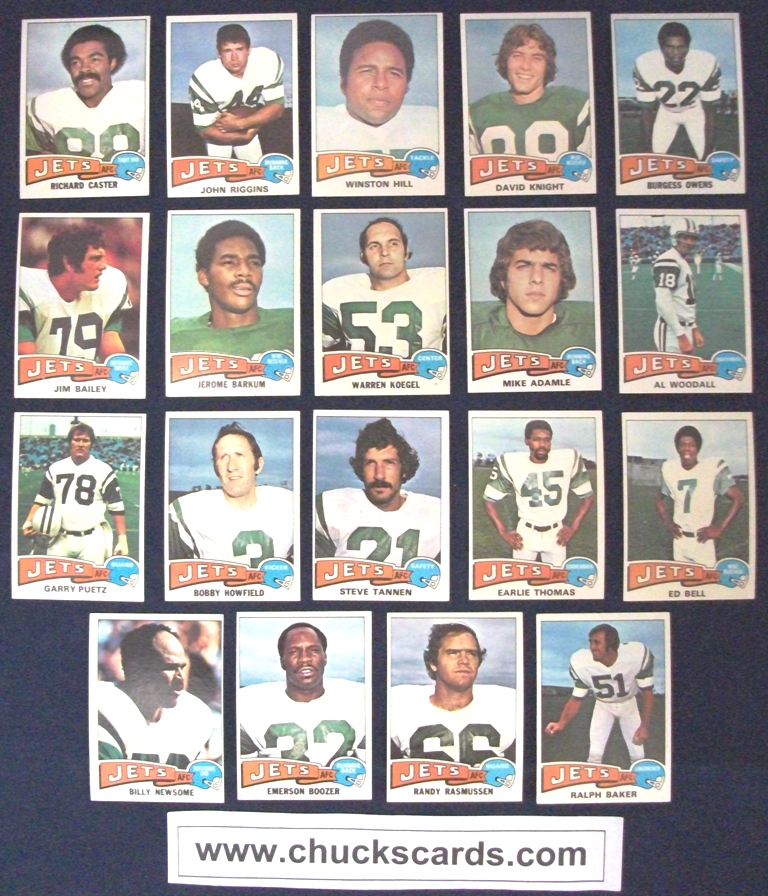
The 1975 Topps card of center Warren Koegel #53 immediately reminds me of a Presidential portrait, or even better, the famous painting of William Blake.  It's the image of a noble personage, a man looking hungrily beyond the the renderer's view.  Maybe that's the way he wanted it.  There weren't many "action" shots for that year's Topps cards.  Most of them were retreads from the years before or were reflective shots where the Jet players were asked to look off in the distance, and the players vacantly obliged.  Some have hands casually on both hips.  One or two try the lame, posed action shot - always amusing, for who are they defending against?  One or two look like they were taken during warm-ups at Foxboro the season before.  Among them all, Koegel's image looks like it belongs to a man who with a vision.  

His nickname was "Moose;" according to a rather detailed article on him for Coastal Carolina University in 2001 (where he was athletic director at the time), this nickname derives from the fact that he wore #14 as a Little Leaguer, the same number as "Moose" Skowron of the Yankees.  His Little League in Seaford, NY was very near the one I played for in North Merrick; what's incredible is that for someone as detail-oriented as I  (and about only a handful of things, mind you) I have no idea what numbers I wore in Little League, or even if I had a number at all.  That's bizarre.  It's another one for my mental health care professional.  

At any rate, Koegel (pronounced "ko-ghel," by the way) was director at Coastal Carolina and is apparently now in the same position at Jacksonville State.  Koegel was the offensive captain for Penn State in the late 60's and early 70's, with Jack Ham as defensive captain.  In the Coastal Carolina link above, there is an interesting detail about the end of Koegel's career in 1975.  He blew out his knee just before halftime in the away game against Kansas City, one of only three wins for the Jets that whole season.  His knee was repaired by Dr. James Nicholas, the eminent Merlin to Joe Namath's Arthur, the sports physician who enabled Joe to play longer than he could or should have.  "I haven't had any trouble with my knee since," Koegel says.  The irony is that Koegel's knee gave out before Joe's heavily braced ones did, which may be a testimony to Nicholas after all.  With the exception of John Riggins, the good doctor was sadly the most talented and able member of the team that year.

****
Out of Michigan State, drafted by the Jets in 2000, #53 Courtney Ledyard's KFFL profile through news releases looks like a journey back in immediate time.  In an instant, we know all the history we need to know, but nothing essential about the man - only the "transactions" of the quickly summarized past.  No looking through microfilm for us, or scrolling through the Reader's Guide to Periodical Literature, searching for "Ledyard, Courtney."  Those days are gone.  One link, one source.  That seems to be what it's all about.  At the above link, we begin with NFL Europe, where he was consigned in September 2001, and then to injuries earlier at the August 2001 camp, then his earlier re-signing in the spring of that year.  Such is Courtney Ledyard, whose name sounds like a band that toured with Lynard Skynard and Molly Hatchet.

****
Mike McKibben #53 arrived at Kent State two years after the shootings that marked the university in the historical mind.  What was it like then, and how did the jock culture at Kent State imagine itself in light of the countercultural community that the Troop G attacked?  How quickly did people need to move on there in order to move on with their lives?  Was it just a peripheral thing after a while, the way it is, probably, for students today?  People pass by the Prentice Hall parking lot to get to class and get on with their destiny.  


Mike McKibben graduated at a good time to join the Jets.  It would have been a good year for my Dad to join the team, and he was 41.  The jobs were available.  In 1979, McKibben's rookie year, the Jets broke even but could have done much better if not for the injuries that wore the team down to a nub.  Missing Pat Leahy alone cost them at least two games.  Mike McKibben became a starter very quickly, and it looks like he played at linebacker in all 16 games of that season.  He played less the year after that and then was out of the NFL.  He then played for Pittsburgh and then Denver in the USFL a year or two later.  Or vice versa.  

Oh c'mon, don't act like you remember their names right off the bat.  The Pittsburgh Maulers and the Denver Gold.  There you go.  There are no stupid questions here.  No one's judging you.  The interesting thing is that the Denver Gold practically replicated the Pittsburgh Steelers' uniform, while the Pittsburgh Maulers' purple logo looked like something out of the WPA.  Remember that the only stupid question is the one not asked.


"Ledyard, Courtney"

Senin, 04 Juli 2011

NY Jets #53 - Part 1

Which of these 1974 Defensive All-Americans
is in the Pro Football Hall of Fame?
Hint: the Jets didn't pick him
With a few exceptions, number 53's on the New York Jets do not exactly charge the memory. The names are like a list of car dealerships in the Tallahassee area. But in the worlds from whence they come, all of these #53's are famous to someone somewhere. The professional football world is as unforgiving to a college football star as it is to the thespian who wins a copy of Stanislaski's An Actor Prepares on awards night at a local high school and finds himself five years later asking for your order at a McDonald's in Manhattan.

Can you spot the Hall of Famer in the Playboy 1974 All-American college football defense? Hint: He was not drafted by the Jets. Another hint: That's not a very good hint. He was actually drafted by the Dallas Cowboys. At the top left hand is Randy White #94, defensive end out of the University of Maryland. The others photographed here, to greater and lesser degrees, had careers in the NFL, but none with White's success. But this is the way it is in life. The player depicted here from Auburn is #53 Ken Bernich, All-American linebacker. He was drafted by the Chargers and then suited up for the Jets in 1975, recovering one fumble, though I don't know in which game. After that, he was done in the NFL. Today he recruits for Auburn even still and is apparently a high school football coach, presumably in Florida.

For me, the only really galling thing is that, again, the only guy above in the Hall of Fame is the guy the Cowboys drafted. It's sick, actually. The Jets did not draft in 1975 until the second round, and they drafted Anthony Davis, the Heisman Trophy winner. I don't think many people know that. I don't know if Davis would have really helped them much, but they did not want to give in to his contractual demands (they had a fairly expensive, wobbly-legged quarterback who had actually won the last last six games of the Jets' 1974 season), so Anthony Davis went on to play for money in the short-lived WFL. The next year, the Jets would draft a first-round quarterback, at long last.

****

Khary (pronounced "Cary") Campbell #53 was linebacker for the Jets from 2002-03, out of Bowling Green. He played sporadically for us and then became a regular with the Redskins at a time when Jets players went to DC like panners to the West. He finished his career with the Texans in 2009. He was a special teams captain with the Redskins, as is depicted as such in the fascinating "men in suits" shot Jim Zorn insisted upon during his brief tenure as Washington's Head Coach. He wanted his captains to exude a look of professionalism which Campbell described as "gangster." (Another teammate preferred to describe the look as "deacon.") Campbell is second from the left.

In February 2009, Campbell took the floor dancing the Macarena at a Redskins fundraiser which featured, yes, former Lt. Col. Oliver North selling raffles table to table. Campbell appears to be a good guy, not really doing the Macarena but dancing to it in order to keep an otherwise dull team obligation a little amusing for everybody. But now I'm wondering what I would do if Oliver North came by my table asking if I'd like to buy a raffle ticket. I'd ask him a couple of questions, maybe. The first would be, "Who the hell let you in here?" The second would be, "Didn't you knowingly divert United States resources to make worthless contacts with military elements in a terrorist-sponsoring nation?" The answer to the first question, of course, would be to some degree former Redskins coach Joe Gibbs and ultimately Daniel Snyder. The answer to the second question is, of course, yes.

****

"Often times, 'overachiever' is code for something like "This team is so bad, they've got Cascadden logging serious time." Slow, unskilled, overwhelmed - the model Jet of his era."

This is how Jeff Pearlman describes linebacker Chad Cascadden #53, who ranks 99th in the Top 100 Worst NFL Players Of All Time, on Deadspin. I'm happy to remind you that Jets players make up 10% of the list. Cascadden is technically the best of the Jets' worst, whereas their worst of the Worst on the list remains Johnny Lam Jones. This is all debatable and frankly skewed. Many, many players in the NFL try their best, but many, many players have no business suiting up. To continue the analogy above, how many actors have you seen in any medium whom you realize simply cannot even find the paper bag out of which they are supposed to act? As a teacher, I've seen a lot of bad teachers. I haven't been pulled over for speeding by many cops but when I have, two out of three have been - by this taxpayer's measurement, at least - really dumb, inarticulate cops. Many of us in this world are slow, unskilled and overwhelmed.

The trick of Pearlman's list is trying to discern the absolute draft washouts (like Lam Jones, theoretically) and/or hyped superstars (like Anthony Davis, who figures at #46!) from pure incompetence cloaked in feigned praise. Actual Underachievers vs. "Overachievers." I'm not sure Cascadden deserves his ranking, though as Pearlman points out, the "overachiever" was often the model Jet during the Kotite era. He had three tackles in eight games in 1996 and five tackles in four games in 1998. Back in the day when our expectations were so low, an "overachiever," which is exactly what I thought of Cascadden during this time, was our hero. It was hard for a Jets fan of the 1990's to judge who was and was not the worst. Our best were often the ones with the best attitude, and on a 3-13 squad (1995) and a 1-15 squad (1996) what the hell else can you expect? By this measurement, Wayne Chrebet was just as good at his position as Chad Cascadden was at linebacker, which of course is not actually true. But when your team is bad for a long time, it's hard to tell real talent from the untalented guys who just work hard.

And while we're back to the topic of draft choices, does anyone know what makes Barry Gardner #53 special? Drafted in 1999 in the second round by the Philadelphia Eagles, he had the benefit of less scrutiny than the top pick, Donovan McNabb. He played three seasons with the Eagles, two with the Browns, one with the Jets in 2005 at linebacker, and apparently one with the New England Patriots where he broke his leg at the start of the 2006 season. Today he is listed as a free agent even still, which means, I believe, that he's retired. His numbers don't put him on any lists of worsts or bests, but that's probably as much as any of us can say for ourselves. This is the way it is in life.

Minggu, 03 Juli 2011

NY Jets #52 - Part 3

In 1997, Thomas "Pepper" Johnson #52 got the call from Bill Parcells. Come join my latest experiment, he says, and the men often take the call and the one-way flight to wherever he is. New Jersey, Foxboro, New Jersey again, Dallas, Miami. There aren't really any players from Parcells' coaching days still active, though if Pepper Johnson could play, I'm sure Parcells would play him. But would Pepper play for him?


Johnson was one of Parcells' favorite defensive players, and considering how much the old man loves defense, that's saying a lot. I saw Pepper Johnson as a Scottie Pippen to Lawrence Taylor's Michael Jordan, if Jordan was a human basket case. Aren't all superstars, by definition, basket cases? Jordan may still appear as a relatively impenetrable star in Hanes ads, but the man is wearing a Hitler mustache. This point cannot be avoided any longer. Does no one on these ads care enough about their product to make him change this? Is the world's most self-assured man trying to see if, like Serbia, he can call contemporary Western civilization's bluff? Or is this some cry for help?

At first glance, Pepper appears to have been playing the role he needed to play as a Jet - as a Parcells man, keeping the program moving forward, playing a inspirational role. But who was he really coming back to New Jersey for in 1997? Answer: the same man for whom he also played as a Giant, and the same man for whom is a linebackers coach today - the Dark Lord, Bill Belichick.

This is why Pepper is now our enemy, though I will always recall him forlornly standing apart the night we lost the AFC Championship to Denver in January 1999. It was his last game with the Jets and his last as an NFL player, and he looked saddened for the way it had to end. I guess I'll never be really bitter about Pepper Johnson helping to make my life a living hell in New England over the past decade the way I should be.


***

1) When we are young, our parents notice details about us that become apocryphal bits of characterization. Johnson's nickname apparently comes from his preference as a child for putting pepper on his cereal. As with any good story, it doesn't matter if it's true or not.

2) Not many people recall Pepper Johnson's celebratory dance, which might be idiotically construed by officials today as "taunting." I used to do it all the time when I was a teenager didn't have anything better to do on the dance floor. It had the effect of producing the same effect that urinating on yourself does in a crowded room.

I can find no evidence of the dance online, and people often say they saw it for the first time at midfield at the end of Super Bowl XXI, but I remember seeing it earlier. It's hard to find a reference to it anywhere online, except in an LA Times article on Giants guard William Roberts and Pepper Johnson doing "The Dog," a dance they evidently learned at their alma mater, Ohio State. This must be the dance. They were dancing The Dog.

3) Did Keith Byars learn the dance? I still don't exactly remember how it goes. All attempts to find a video of it online have only produced films of dancing dogs. But anytime I feel angry at Pepper Johnson's devotion to Bill Belichick, I will be able to remember what Keith Byars did to Pepper in 1988. I've mentioned it before in reference to Byars. You will never see a 6'3" 250 lb man fly as far as Pepper Johnson did that day. That's what you get for not teaching a Heisman runner-up The Dog, he seems to say.

****

Steve Reese, LB, 1976 Bucs
In 1975, I saw linebacker Steve Reese #52 in in the program for two games for the Jets at Shea Stadium, against the Colts and Steelers. I remember seeing his face In 1976, I saw him play one game at Shea Stadium, this time as a Buccaneer against the Jets, and this was his picture in the program. The Jets won 34-0. That game was one of the two times the Jets' total offense went over 300 yards all season, and as bad as the Jets were that year, the 1976 Buccaneers have a very special place in the history of American sports in terms of ineptitude. They left even their skeptics in awe of how bad they were. It's time for somebody to make a major film about a winless team dressed in sherbet orange at the dawning age of American decline.

I remember looking at this head shot and wondering what it was like to play for teams as progressively poor as the 1975 Jets and then 1976 Bucs. By the age of seven, I had come to grasp and accept the reality of the Jets' losing with a new zeal but also with a sense of the humbling nature of human existence. The only consolation I might have taken was what many of us - even children - believed we were witnessing when the orange Bucs took the field - that some kind of history was being made, the kind that wouldn't be repeated for a long, long time. If you loved a losing team, as I did, then you were endeared to the Buccaneers. Other kids I grew up with were enamored of winners only, the Steelers and the Cowboys, or later the Broncos and the 49ers. As the song goes, some side with the leaves, some side with the seeds. If you loved only winners, you always loved only a winner. When you loved a loser, then you loved all the losers who turned it around, as the Bucs did in 1979. And I root for the Detroit Lions just as sympathetically as Besitkas roots for Pluto.

Jumat, 01 Juli 2011

The new URL


For reasons that appeared to make sense to me at the time, my new URL is, as it is above:


infinitejets.blogspot.com

From now on, the blog and I will also be united in a skin-fitting, organic-synthetic hybrid ectoplasm. And that should make everything OK.


If you got here, then you know that already, I guess.  If you don't know that, I don't know how I'll reach you.  But this is the price you pay when you make changes.  Make note, Rex Ryan.  My hope is that anyone interested will find us. 

NY Jets #52 - Part 2

This is a poignant image of David Harris #52. It's the portrait of a man who got to Peyton Manning twice during the 2010 AFC Championship and played an overall good game, but still found himself surrounded by the blue and white confetti of the opposing team in the end. He looks like he's done for the season, but not for his career. He looks like he could be ready for another game. His mind is only grasping that it's the end of the season. Everything else seems ready for more. He took the loss that year better than I did. We could have beaten the Colts in the title game. They looked frightened for a while, and then they didn't. David Harris had them thinking for a while, but then he didn't. When it's over, you find yourself numb, staring straight ahead, just as David Harris seems to be, wondering if it could have gone your way after all, hurting more and more with each passing minute because you know it could have.

I think it's still worse for the fan. David Harris makes a lot of money as a consolation, and by the standards of the salaries players earn he deserves it well enough. He is one of the best Jets linebackers ever. He has that consolation as well. Two AFC Championship losses for me have been exciting and new, but bitter all the same, and the long winters that have followed the two senseless losses to consecutive losing Super Bowl clubs have been very hard. When I retire, I will retire to Florida. That's all I have to say. I don't care how cliche it is.  It will be easier to be a football fan in Miami, even if the Dolphins are there.

It would be ridiculous to imagine, as I have, David Harris playing alongside Jonathan Vilma today. Harris actually took over for Vilma at inside linebacker when the latter was put on injured reserve back in 2007. Statistically, though, is Harris a better linebacker? I would argue so, though it's a tough call. He has near as many tackles in as many years as Vilma, and both have been injured for extended periods. What if David Harris has an even better year next year, or whatever year they decide to play professionally again? What's great is to be in a place and in a time when you can imagine such a thing. This is what it is to be a Jets fan in the present time. In eternal time, the only thing you have to worry about is the absurd but tangible possibility of freak injury. Cruel fate. We can console ourselves that these may be the best of times, but why can't we hope for even better? Is it too much to ask? History, sadly, tells us yes, very likely. 

Meanwhile, I will reassure myself with this:


****

Mike Hennigan #52 began his career at linebacker with the Detroit Lions in 1972 and finished it in 1978 with the Jets after three seasons. Since there were no records kept of any specifics in defensive performance, we have nothing really to go on. He did coach his alma mater's football team at Tennessee Tech football team for about a decade. In 2006, he stepped down from that job for medical reasons which remained unspecified. I must have seen him play about five times at Shea.

****
Mike Hudock is the first #52 in franchise history, playing center for the Titans and the Jets from 1960-65. As there is a bizarre and unspoken intimacy between a quarterback and his center, it should be noted that Hudock, who died in 2003, was probably Joe Namath's first center in professional football and perhaps even the first starting center in Miami Dolphins franchise history. But no one remembers centers. There's Jim Otto, Mike Webster.

Born in Luzerne County, Pennsylvania, Jim Hudock traveled far outside the coal mines of his home to the University of Florida. He was apparently drafted by the Green Bay Packers in 1956, but they had a regular starting center in Jim Ringo, and there doesn't seem to be any record of his professional existence until he appears, as he does above, at the Polo Grounds in a New York Titans uniform. He played consistently through the Titan franchise going green and white, then moving on to Miami in 1966, and he even played a spate of games for the Chiefs the following year. He was an original AFL man.

Then as now, centers are never known for their flamboyance but instead for consistency, solidness and presence. Optically, in the card above, it seems as if Mike Hudock casts a presence as large as the idea of team's name - as a titan, from a race of ancient deities doomed to be overthrown by the younger gods. The mere mortals in white shirts near Mike Hudock's feet walk aimlessly about the old arena and are dwarfed by him, while the arena itself seems too small to hold his giant frame.

Of course, the New York Titans' name became an ironic footnote, like Edsel onto Ford. Their outdated arena was actually too large for the small handfuls who would casually arrive on Sunday. Jean Shepherd once said that Titan games at the Polo Grounds were delightful to attend because the bare hundreds who would show up would gradually find one another, sit together and idly chat like generally disinterested parents at a child's peewee sports game, all while the real match on the field went silently on, punctuated only by a referee's whistle that would echo around the Grounds' horseshoe. An ancient from an ancient time, Mike Hudock stands atop this already outdated world, and though he will survive the very beginning of the end of the old era, the new gods, with their mustaches, white shoes, mink coats and outrageous demands, are awaiting their turn.